Vancouver’s Dirty 30s

In 1936, Oppenheimer Park was declared the only park where political, religious or other views could be publicly voiced. Previously known as the Powell Street Grounds, it was already a favourite for rallies and demonstrations.

The 1930s in Vancouver
As a background to this article, the following documentary film (24 minutes in length) portrays the environment of the day, with the stock market crash leading to the depression when an unprecedented number of Canadians suffered poverty due to unemployment. Subsequently, the Government attempted to deal with the unemployed. There are considerable images of Vancouver in this film.
Dates for context
- Marine Building opened October 1930
- Vancouver Airport opened July 22, 1931
- Burrard Bridge opened July 1, 1932
- Vancouver Coroner’s Court and City Morgue, 238-240 E. Cordova opened September 17, 1932
- Hotel Vancouver (#3) started 1928 but halted in 1932 due to the depression; remained vacant for five years
- City Hall construction starts October 5, 1935 at 12th/Cambie, the site formerly known as Strathcona Park
- St. James Anglican Church (Gore / Cordova) cornerstone laid November 11, 1935

In 1936, Oppenheimer Park was declared the only park where political, religious or other views could be publicly voiced.
Previously known as the Powell Street Grounds, it was already a favourite for rallies and demonstrations.

Go West Young Man
Vancouver was the terminus for those who travelled across the country looking for work. Hobo Jungles popped up, built under the old Georgia viaduct, along the False Creek shoreline and the railyards of Strathcona. In 1932, 14% of Vancouverites were jobless.


The federal and provincial governments set up work (or relief) camps, where upwards of 6000 single men voluntarily entered, were housed and fed, made 20 cents per day and laboured 44 hours per week, building roads (Cariboo Road, Harrison Hot Springs Road), doing landscaping (Peace Arch Park), and constructing public buildings.
It wasn’t until 1936, with a change of federal government, that these camps were shut down. Across Canada, more than 170,000 men had stayed in one.


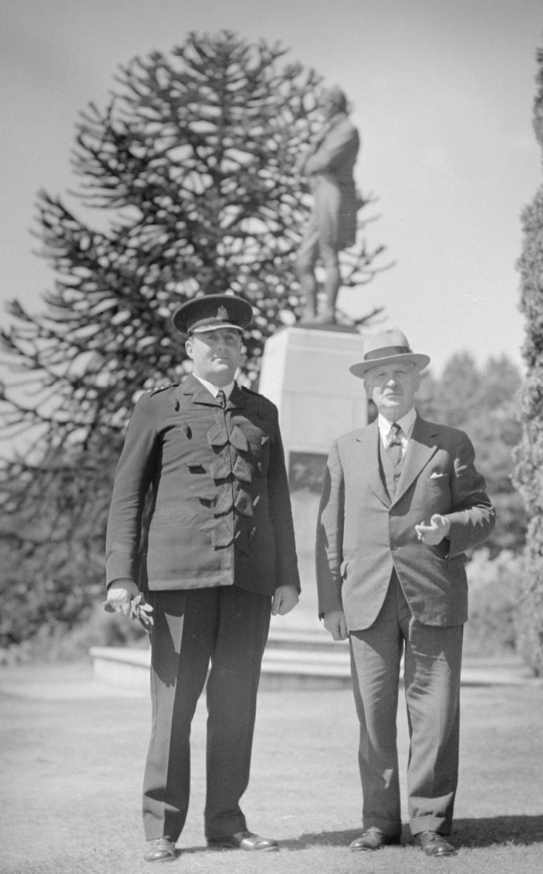
In the City, unemployed and bankrupt citizens couldn’t afford to pay their property taxes. The cost of welfare, which was deemed a municipal responsibility (according to the Prime Minister of Canada), soared. Vancouver defaulted on creditor payments and in his mayoral campaign promise, Gerry McGeer vowed to oppose these creditors, plus fight crime by abolishing gambling and corruption in the police force. He won a landslide victory against Mayor Louis D. Taylor in December 1934.[*1]
In one of his first civic duties, Mayor McGeer fired Chief Constable John Cameron. Cameron had formerly been a Vancouver Police officer from 1911 to 1929, then moved into the position as Chief Constable with New Westminster, before his appointment as Chief of Vancouver Police in February 1933. Cameron and 17 officers were suspended under unsubstantiated allegations of systemic corruption, in what was called the “McGeer Purge.”[*2]
The Year from Hell
Nineteen-thirty-five began with the appointment of a new Chief Constable, William Wasbrough Foster. Mayor McGeer’s Shaughnessy neighbour had no previous policing experience, but impressive military credentials, was a veteran lumber executive (Managing Director of the Globe Lumber Company, Vancouver Island) and later General Manager of Evans, Coleman & Evans (an 1888 waterfront-based import-export and building supply business, reliant upon the Shipping Federation).[*3] Colonel W.W. Foster was to take charge of the Vancouver Police at a time when unemployment in the city was widespread and the morale of the force was low.


In April 1935, approximately 2000 men from various work camps returned to the city to engage in demonstrations, joining other unemployed citizens. They were demanding improved living conditions and new work programs from Ottawa. Their protests, at first, were relatively peaceful.
On April 23, protest organizers planned diversions at unnamed merchant locations, as part of the demonstration. Leaving their HQ (318 W. Cordova), the route took the marchers into Gastown before heading to the Hudson’s Bay Company. Initially calm, a melee soon occurred when police reinforcements arrived to remove the strikers. Considerable damage ensued (39 plate glass windows broken), and six policemen were injured.

The march progressed north and east to Victory Square, while a delegation of 12 strikers attended City Hall (then located in the Holden building at 16 E. Hastings) to meet the mayor.
Meanwhile, Mayor McGeer, Chief Foster, and uniformed officers (Vancouver, RCMP and BC Provincial Police) met the marchers, and the Riot Act was officially read to “the mob of about 3,000 strikers and sympathizers,” but also included curious onlookers. The large group eventually dispersed.
That night, search warrants in hand, the police raided various strike headquarters. Upon hearing this, crowds of strikers amassed at City Hall (Carrall and Hastings); fights broke out, windows were broken and the police attended to break up the disturbance, acquiring calm around midnight. All told, 19 were arrested this date.


Vancouver News Herald, Apr 24, 1935 – pages 1 & 2 (click to enlarge)


Early in 1935, Mayor McGeer established a funding source [*4] to initiate construction of a new City Hall along with accompanying infrastructure. Chief Foster was able to garner the Mayor’s support for a police training school ($10,000 budget, later increased to $50,000, and included intelligence funding) and hiring hundreds of (armed) special constables. It was thought that their value would be to combat communism. Pay was $3.60 a day.

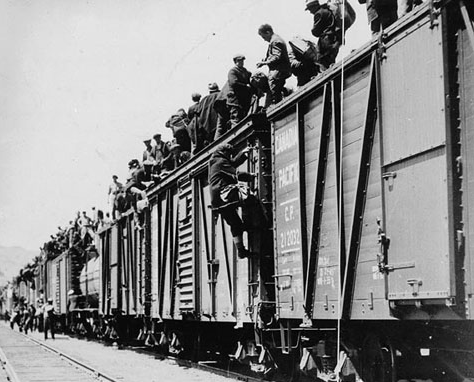
In June 1935, two further events occurred: The Battle of Ballantyne Pier and the On-To-Ottawa Trek. The latter was an attempt by the unemployed masses to air their grievances in Ottawa. To that end, hundreds boarded trains eastward. On July 1, 1935, the protest ended in violence when Regina Police clashed with the strikers. Three hours later, City Detective Charles Millar lay dead, 100 were injured, shots were fired, tear gas deployed, damage resulted, and multiple arrests occurred.


Meanwhile, back in Vancouver, the city’s longshoremen, heavily influenced by the communist “Red Menace” (Worker’s Unity League, a militant union arm of the Communist Party) was in dispute with the Shipping Federation of BC. The union was locked out and non-union replacements were brought in.
A strike had begun.
 On June 18th, 1000 striking longshoremen, joined by war veterans under a Union Jack flag, marched to Ballantyne Pier. They were met by Chief Foster at Alexander / Heatley. An order to disperse was ignored, the Chief called for tear gas and his men advanced. Rocks and debris were thrown, and the mounted squad moved in. The chaos moved along Powell; thus, this also became known as the Powell Street Riot.
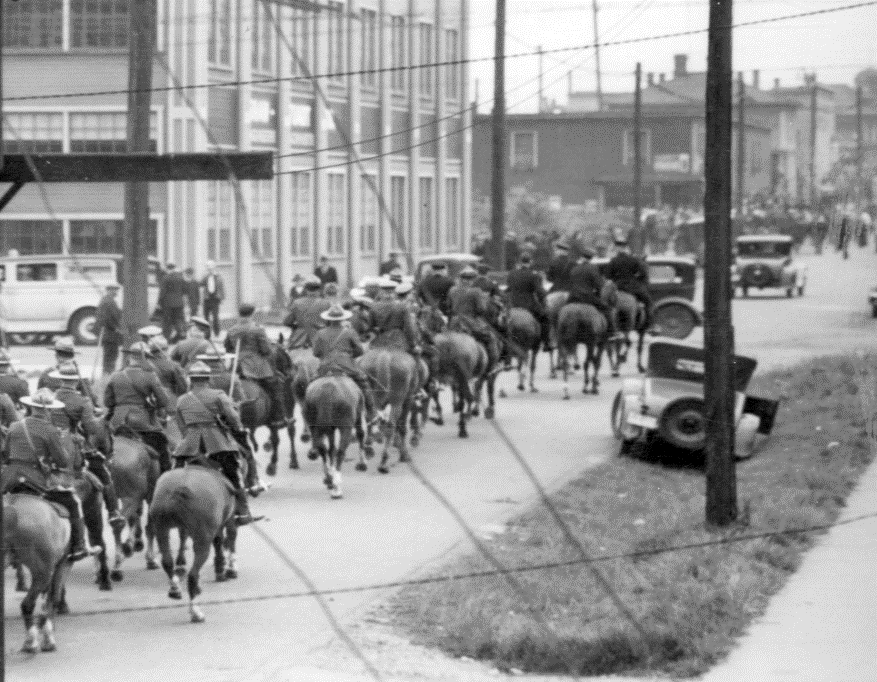
The aftermath resulted in 28 injuries and 24 arrests for unlawful assembly and assault. Mayor McGeer declared striking longshoremen were no longer eligible for relief payments.
The strike ended December 1935. While the “˜battle’ lasted only three hours, animosity between labour and police was to last for years.


An interesting anecdote regarding Chief Foster: on September 21, 1935, during one of his regular evening street patrols, with his driver Constable #163 John W. McKinnon, the car radio broadcast a robbery. The call sounded similar to a rash of robberies of small grocery and drug stores that had been occurring throughout the city (Silk Stocking Bandits). The plate number was given of the stolen getaway vehicle, which was then seen by Chief Foster, travelling in his opposite direction on Granville Street near Broadway. Pulling a u-turn, McKinnon followed the car, travelling at a “terrific rate”, the bandits opened fire on the Chief’s car with shotgun and revolvers. Bullets punctured the radiator, chipped paint, hit but didn’t pierce, the shatterproof windshield. The Chief returned fire, across Granville and Cedar Streets, the suspect vehicle blew one of its rear tires, but continued onwards at 70mph.
At Maple Street, the suspects failed to make the southbound turn, ending on the boulevard. The gunmen jumped out and ran eastbound separating. Foster followed a pair who ran east in the north lane of 7th Avenue while McKinnon chased down those running between houses at 6th Avenue. McKinnon fired three shots, the last hitting one of the suspects “who flinched, staggered and collapsed on the roadway.”
Simultaneously, Chief Foster opened fire on his suspects, striking one, but they continued onwards, disappearing into the thick brush. Reinforcements arrived, but three of the bandits eluded police. Two fully-loaded, double-barreled, sawed-off shotguns and a Luger automatic pistol were recovered. Earlier, these suspects had been responsible for three robberies; and previously at least 28 others. One in custody, 18-year-old Elmer Almquist was sentenced to four years in the penitentiary and 15 strokes of the paddle. One accomplice, William Gates, was arrested later that night, also sentenced to five years and 15 strokes.
Nineteen-thirty-six was the Golden (50th) anniversary of the Department, and the following initiatives were carried out under Chief Foster’s leadership:
- Schoolboy Patrols – providing children a safe crossing to get to school
- Uniform design – high neck tunic replaced by a more comfortable collar and tie
In 1937, the Department was reorganized to create a new Division: the Statistical Bureau. Their role was to track crime trends and find criminal commonalities, a first in Canadian police forces.
Bloody Sunday
In 1938, while unemployment was still prevalent, Mayor McGeer cut off relief. A sit-down occupation was planned for the main post office (Hastings/Granville ““ Sinclair Centre), the Georgia Hotel, and the Art Gallery on May 11th. Management at the hotel promised $500 in relief to the unemployed, and the protestors left. Those at the Art Gallery and post office awaited a response from Ottawa, which never came.
For the next five weeks, it was business as unusual, and the authorities were dutifully embarrassed. On the morning of June 20, Vancouver Police attended the Art Gallery, asked the protestors to leave, and when they refused, tear gas was thrown to clear the demonstrators. The RCMP took on the post office, using tear gas and truncheons as they faced resistance. As people fled the site, pursued by police, windows were smashed along the way, predominantly at Spencer’s and Woodward’s Department Stores (80 windows). Vancouver officers attended to assist their federal comrades.
The crowd gathered at the Powell Street Grounds (Oppenheimer Park), seeking refuge at the Ukrainian Labour Temple and at the offices of Harold Winch, MLA. Later in the afternoon, 2000 people lay siege to Vancouver Police headquarters, demanding the release of prisoners from the City Jail. Police stood their ground, and 30 minutes later, the crowd dispersed.
As a result of the riot, 39 police and unemployed were hospitalized. During the riot, one Mounted member, John Davies, was struck on the leg by an iron bar, breaking the bone, but he managed to stay in the saddle. Cst. Edward Hembing suffered head injuries and a concussion. Another lost their handgun. Fundamental changes were made to the uniform post-event; members were issued a new .38 revolver and Sam Browne belt to be worn outside the tunic, with a closed holster.


On October 13, 1939, Colonel (Chief) Foster was granted indefinite leave of absence for military service. During his absence, the Police Commission opted not to replace him permanently, as the war was not expected to last long. Assistant Chief Constable Donald McKay, with the Department since 1907, was placed into the acting role. Two years later, in the summer of 1941, it was apparent that the war was going to last longer than anticipated, and Foster tendered his resignation (August 20, 1941) to the Police Commission. McKay was confirmed in the rank and made Vancouver’s 17th Chief Constable.
Footnotes
[*1] Gerry McGeer served as the prosecuting attorney in 1928 during a corruption investigation involving Mayor Louis D. Taylor. Taylor was cleared of any wrongdoing.
[*2] All but one were later exonerated and taken back on strength, albeit at lower ranking positions.
[*3] Vancouver Daily World, Nov 7, 1923 page 1; Mediator is Active in Strike
[*4] Funding from the sale of “Baby Bonds,” initially intended for citizen contribution to a new City Hall to encourage civic pride, while remedying the City’s financial situation. They were, for the most part, purchased by large business such as Imperial Oil and Canadian Pacific Railway. When ground was broken October 1935, many bonds hadn’t yet sold.
References
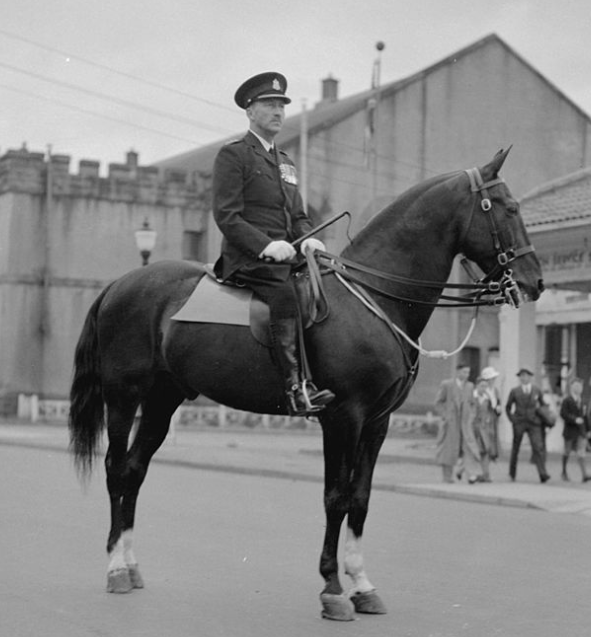
CVA 480-189 – Mounted Squad at the Old Courthouse, 1938 (Chief Foster on the left)
CVA Re N9.2 & Re N3.1 – Three unemployed men & the Jungle at the Dump, Sept 1931
CVA Re N10.03 -The Jungle of the unemployed, summer of 1931
CVA 99-2643 – May Day demonstration crowds at Powell Street grounds – c1932
National Archives of Canada C-027899 – Demonstration in Great Depression (Powell Street Grounds)
National Archives of Canada C-079022 – Relief Demonstration in Vancouver, 1937
Battle of Ballantyne Pier – various stock images, no known source
BC Archives G-03284 – Special Constables in front of the Provincial Courthouse (today’s VAG) – 1935
CVA Bu P217 – Exterior of Hudson’s Bay Co., NE Corner Georgia & Granville – 1935
CVA 2011-010.1697 – Post Office sit-in (during eviction of protestors from post office building), 1938
CVA 2011-010.1695 – Post Office sit-in (police removing man from building), 1938
CVA 2011-010.1694 – Post Office sit-in (damage to storefront), 1938
Vancouver News Herald – Apr 24, 1935, pages 1 & 2
Vancouver Sun – Apr 24, 1935, pages 1, 2 & 10
Vancouver Sun – Jun 4, 1935, page 1
The Regina Leader-Post – July 1, 1935, pages 1 & 9
New Chief on the Job – Province, Jan 4, 1935, pg 1
Vancouver Sun – Jan 3, 1935, pages 1 & 3
Chief Captures Bandit Suspect -Vancouver News-Herald, Sep 23, 1935, page 1
From Canvas to Concrete in 50 Years – The Construction of Vancouver City Hall, 1935-36; David Monteyne 1999/2000
The Chuck Davis History of Metropolitan Vancouver, Chuck Davis, 2011
Constituting Authority: Policing Workers and the Consolidation of Police Power in Vancouver, 1918-1939; Lani Russwurm 2007
A Century of Service; Joe Swan 1986